| Function | Funktion | Description |
| Add-in and Automation functions | Add-In- und Automatisierungsfunktionen | |
| CALL | AUFRUFEN | Calls a procedure in a dynamic link library or code resource |
| EUROCONVERT | EUROCONVERT | Converts a number to euros, converts a number from euros to a euro member currency, or converts a number from one euro member currency to another by using the euro as an intermediary (triangulation) |
| GETPIVOTDATA | PIVOTDATENZUORDNEN | Returns data stored in a PivotTable report |
| REGISTER.ID | REGISTER.KENNUMMER | Returns the register ID of the specified dynamic link library (DLL) or code resource that has been previously registered |
| SQL.REQUEST | SQL.REQUEST | Connects with an external data source and runs a query from a worksheet, then returns the result as an array without the need for macro programming |
| Cube functions | Cubefunktionen | |
| CUBEKPIMEMBER | CUBEKPIELEMENT | Returns a key performance indicator (KPI) name, property, and measure, and displays the name and property in the cell. A KPI is a quantifiable measurement, such as monthly gross profit or quarterly employee turnover, used to monitor an organization's performance. |
| CUBEMEMBER | CUBEELEMENT | Returns a member or tuple in a cube hierarchy. Use to validate that the member or tuple exists in the cube. |
| CUBEMEMBERPROPERTY | CUBEELEMENTEIGENSCHAFT | Returns the value of a member property in the cube. Use to validate that a member name exists within the cube and to return the specified property for this member. |
| CUBERANKEDMEMBER | CUBERANGELEMENT | Returns the nth, or ranked, member in a set. Use to return one or more elements in a set, such as the top sales performer or top 10 students. |
| CUBESET | CUBEMENGE | Defines a calculated set of members or tuples by sending a set expression to the cube on the server, which creates the set, and then returns that set to Microsoft Office Excel. |
| CUBESETCOUNT | CUBEMENGENANZAHL | Returns the number of items in a set. |
| CUBEVALUE | CUBEWERT | Returns an aggregated value from a cube. |
| Database functions | Datenbankfunktionen | |
| DAVERAGE | DBMITTELWERT | Returns the average of selected database entries |
| DCOUNT | DBANZAHL | Counts the cells that contain numbers in a database |
| DCOUNTA | DBANZAHL2 | Counts nonblank cells in a database |
| DGET | DBAUSZUG | Extracts from a database a single record that matches the specified criteria |
| DMAX | DBMAX | Returns the maximum value from selected database entries |
| DMIN | DBMIN | Returns the minimum value from selected database entries |
| DPRODUCT | DBPRODUKT | Multiplies the values in a particular field of records that match the criteria in a database |
| DSTDEV | DBSTDABW | Estimates the standard deviation based on a sample of selected database entries |
| DSTDEVP | DBSTDABWN | Calculates the standard deviation based on the entire population of selected database entries |
| DSUM | DBSUMME | Adds the numbers in the field column of records in the database that match the criteria |
| DVAR | DBVARIANZ | Estimates variance based on a sample from selected database entries |
| DVARP | DBVARIANZEN | Calculates variance based on the entire population of selected database entries |
| Date and time functions | Datums- und Zeitfunktionen | |
| DATE | DATUM | Returns the serial number of a particular date |
| DATEVALUE | DATWERT | Converts a date in the form of text to a serial number |
| DAY | TAG | Converts a serial number to a day of the month |
| DAYS360 | TAGE360 | Calculates the number of days between two dates based on a 360-day year |
| EDATE | EDATUM | Returns the serial number of the date that is the indicated number of months before or after the start date |
| EOMONTH | MONATSENDE | Returns the serial number of the last day of the month before or after a specified number of months |
| HOUR | STUNDE | Converts a serial number to an hour |
| MINUTE | MINUTE | Converts a serial number to a minute |
| MONTH | MONAT | Converts a serial number to a month |
| NETWORKDAYS | NETTOARBEITSTAGE | Returns the number of whole workdays between two dates |
| NOW | JETZT | Returns the serial number of the current date and time |
| SECOND | SEKUNDE | Converts a serial number to a second |
| TIME | ZEIT | Returns the serial number of a particular time |
| TIMEVALUE | ZEITWERT | Converts a time in the form of text to a serial number |
| TODAY | HEUTE | Returns the serial number of today's date |
| WEEKDAY | WOCHENTAG | Converts a serial number to a day of the week |
| WEEKNUM | KALENDERWOCHE | Converts a serial number to a number representing where the week falls numerically with a year |
| WORKDAY | ARBEITSTAG | Returns the serial number of the date before or after a specified number of workdays |
| YEAR | JAHR | Converts a serial number to a year |
| YEARFRAC | BRTEILJAHRE | Returns the year fraction representing the number of whole days between start_date and end_date |
| Engineering functions | Konstruktionsfunktionen | |
| BESSELI | BESSELI | Returns the modified Bessel function In(x) |
| BESSELJ | BESSELJ | Returns the Bessel function Jn(x) |
| BESSELK | BESSELK | Returns the modified Bessel function Kn(x) |
| BESSELY | BESSELY | Returns the Bessel function Yn(x) |
| BIN2DEC | BININDEZ | Converts a binary number to decimal |
| BIN2HEX | BININHEX | Converts a binary number to hexadecimal |
| BIN2OCT | BININOKT | Converts a binary number to octal |
| COMPLEX | KOMPLEXE | Converts real and imaginary coefficients into a complex number |
| CONVERT | UMWANDELN | Converts a number from one measurement system to another |
| DEC2BIN | DEZINBIN | Converts a decimal number to binary |
| DEC2HEX | DEZINHEX | Converts a decimal number to hexadecimal |
| DEC2OCT | DEZINOKT | Converts a decimal number to octal |
| DELTA | DELTA | Tests whether two values are equal |
| ERF | GAUSSFEHLER | Returns the error function |
| ERFC | GAUSSFKOMPL | Returns the complementary error function |
| GESTEP | GGANZZAHL | Tests whether a number is greater than a threshold value |
| HEX2BIN | HEXINBIN | Converts a hexadecimal number to binary |
| HEX2DEC | HEXINDEZ | Converts a hexadecimal number to decimal |
| HEX2OCT | HEXINOKT | Converts a hexadecimal number to octal |
| IMABS | IMABS | Returns the absolute value (modulus) of a complex number |
| IMAGINARY | IMAGINÄRTEIL | Returns the imaginary coefficient of a complex number |
| IMARGUMENT | IMARGUMENT | Returns the argument theta, an angle expressed in radians |
| IMCONJUGATE | IMKONJUGIERTE | Returns the complex conjugate of a complex number |
| IMCOS | IMCOS | Returns the cosine of a complex number |
| IMDIV | IMDIV | Returns the quotient of two complex numbers |
| IMEXP | IMEXP | Returns the exponential of a complex number |
| IMLN | IMLN | Returns the natural logarithm of a complex number |
| IMLOG10 | IMLOG10 | Returns the base-10 logarithm of a complex number |
| IMLOG2 | IMLOG2 | Returns the base-2 logarithm of a complex number |
| IMPOWER | IMAPOTENZ | Returns a complex number raised to an integer power |
| IMPRODUCT | IMPRODUKT | Returns the product of complex numbers |
| IMREAL | IMREALTEIL | Returns the real coefficient of a complex number |
| IMSIN | IMSIN | Returns the sine of a complex number |
| IMSQRT | IMWURZEL | Returns the square root of a complex number |
| IMSUB | IMSUB | Returns the difference between two complex numbers |
| IMSUM | IMSUMME | Returns the sum of complex numbers |
| OCT2BIN | OKTINBIN | Converts an octal number to binary |
| OCT2DEC | OKTINDEZ | Converts an octal number to decimal |
| OCT2HEX | OKTINHEX | Converts an octal number to hexadecimal |
| Financial functions | Finanzmathematische Funktionen | |
| ACCRINT | AUFGELZINS | Returns the accrued interest for a security that pays periodic interest |
| ACCRINTM | AUFGELZINSF | Returns the accrued interest for a security that pays interest at maturity |
| AMORDEGRC | AMORDEGRK | Returns the depreciation for each accounting period by using a depreciation coefficient |
| AMORLINC | AMORLINEARK | Returns the depreciation for each accounting period |
| COUPDAYBS | ZINSTERMTAGVA | Returns the number of days from the beginning of the coupon period to the settlement date |
| COUPDAYS | ZINSTERMTAGE | Returns the number of days in the coupon period that contains the settlement date |
| COUPDAYSNC | ZINSTERMTAGNZ | Returns the number of days from the settlement date to the next coupon date |
| COUPNCD | ZINSTERMNZ | Returns the next coupon date after the settlement date |
| COUPNUM | ZINSTERMZAHL | Returns the number of coupons payable between the settlement date and maturity date |
| COUPPCD | ZINSTERMVZ | Returns the previous coupon date before the settlement date |
| CUMIPMT | KUMZINSZ | Returns the cumulative interest paid between two periods |
| CUMPRINC | KUMKAPITAL | Returns the cumulative principal paid on a loan between two periods |
| DB | GDA2 | Returns the depreciation of an asset for a specified period by using the fixed-declining balance method |
| DDB | GDA | Returns the depreciation of an asset for a specified period by using the double-declining balance method or some other method that you specify |
| DISC | DISAGIO | Returns the discount rate for a security |
| DOLLARDE | NOTIERUNGDEZ | Converts a dollar price, expressed as a fraction, into a dollar price, expressed as a decimal number |
| DOLLARFR | NOTIERUNGBRU | Converts a dollar price, expressed as a decimal number, into a dollar price, expressed as a fraction |
| DURATION | DURATION | Returns the annual duration of a security with periodic interest payments |
| EFFECT | EFFEKTIV | Returns the effective annual interest rate |
| FV | ZW | Returns the future value of an investment |
| FVSCHEDULE | ZW2 | Returns the future value of an initial principal after applying a series of compound interest rates |
| INTRATE | ZINSSATZ | Returns the interest rate for a fully invested security |
| IPMT | ZINSZ | Returns the interest payment for an investment for a given period |
| IRR | IKV | Returns the internal rate of return for a series of cash flows |
| ISPMT | ISPMT | Calculates the interest paid during a specific period of an investment |
| MDURATION | MDURATION | Returns the Macauley modified duration for a security with an assumed par value of $100 |
| MIRR | QIKV | Returns the internal rate of return where positive and negative cash flows are financed at different rates |
| NOMINAL | NOMINAL | Returns the annual nominal interest rate |
| NPER | ZZR | Returns the number of periods for an investment |
| NPV | NBW | Returns the net present value of an investment based on a series of periodic cash flows and a discount rate |
| ODDFPRICE | UNREGER.KURS | Returns the price per $100 face value of a security with an odd first period |
| ODDFYIELD | UNREGER.REND | Returns the yield of a security with an odd first period |
| ODDLPRICE | UNREGLE.KURS | Returns the price per $100 face value of a security with an odd last period |
| ODDLYIELD | UNREGLE.REND | Returns the yield of a security with an odd last period |
| PMT | RMZ | Returns the periodic payment for an annuity |
| PPMT | KAPZ | Returns the payment on the principal for an investment for a given period |
| PRICE | KURS | Returns the price per $100 face value of a security that pays periodic interest |
| PRICEDISC | KURSDISAGIO | Returns the price per $100 face value of a discounted security |
| PRICEMAT | KURSFÄLLIG | Returns the price per $100 face value of a security that pays interest at maturity |
| PV | BW | Returns the present value of an investment |
| RATE | ZINS | Returns the interest rate per period of an annuity |
| RECEIVED | AUSZAHLUNG | Returns the amount received at maturity for a fully invested security |
| SLN | LIA | Returns the straight-line depreciation of an asset for one period |
| SYD | DIA | Returns the sum-of-years' digits depreciation of an asset for a specified period |
| TBILLEQ | TBILLÄQUIV | Returns the bond-equivalent yield for a Treasury bill |
| TBILLPRICE | TBILLKURS | Returns the price per $100 face value for a Treasury bill |
| TBILLYIELD | TBILLRENDITE | Returns the yield for a Treasury bill |
| VDB | VDB | Returns the depreciation of an asset for a specified or partial period by using a declining balance method |
| XIRR | XINTZINSFUSS | Returns the internal rate of return for a schedule of cash flows that is not necessarily periodic |
| XNPV | XKAPITALWERT | Returns the net present value for a schedule of cash flows that is not necessarily periodic |
| YIELD | RENDITE | Returns the yield on a security that pays periodic interest |
| YIELDDISC | RENDITEDIS | Returns the annual yield for a discounted security; for example, a Treasury bill |
| YIELDMAT | RENDITEFÄLL | Returns the annual yield of a security that pays interest at maturity |
| Information functions | Informationsfunktionen | |
| CELL | ZELLE | Returns information about the formatting, location, or contents of a cell |
| ERROR.TYPE | FEHLER.TYP | Returns a number corresponding to an error type |
| INFO | INFO | Returns information about the current operating environment |
| ISBLANK | ISTLEER | Returns TRUE if the value is blank |
| ISERR | ISTFEHL | Returns TRUE if the value is any error value except #N/A |
| ISERROR | ISTFEHLER | Returns TRUE if the value is any error value |
| ISEVEN | ISTGERADE | Returns TRUE if the number is even |
| ISLOGICAL | ISTLOG | Returns TRUE if the value is a logical value |
| ISNA | ISTNV | Returns TRUE if the value is the #N/A error value |
| ISNONTEXT | ISTKTEXT | Returns TRUE if the value is not text |
| ISNUMBER | ISTZAHL | Returns TRUE if the value is a number |
| ISODD | ISTUNGERADE | Returns TRUE if the number is odd |
| ISREF | ISTBEZUG | Returns TRUE if the value is a reference |
| ISTEXT | ISTTEXT | Returns TRUE if the value is text |
| N | N | Returns a value converted to a number |
| NA | NV | Returns the error value #N/A |
| TYPE | TYP | Returns a number indicating the data type of a value |
| Logical functions | Logische Funktionen | |
| AND | UND | Returns TRUE if all of its arguments are TRUE |
| FALSE | FALSCH | Returns the logical value FALSE |
| IF | WENN | Specifies a logical test to perform |
| IFERROR | WENNFEHLER | Returns a value you specify if a formula evaluates to an error; otherwise, returns the result of the formula |
| NOT | NICHT | Reverses the logic of its argument |
| OR | ODER | Returns TRUE if any argument is TRUE |
| TRUE | WAHR | Returns the logical value TRUE |
| Lookup and reference functions | Nachschlage- und Verweisfunktionen | |
| ADDRESS | ADRESSE | Returns a reference as text to a single cell in a worksheet |
| AREAS | BEREICHE | Returns the number of areas in a reference |
| CHOOSE | WAHL | Chooses a value from a list of values |
| COLUMN | SPALTE | Returns the column number of a reference |
| COLUMNS | SPALTEN | Returns the number of columns in a reference |
| HLOOKUP | HVERWEIS | Looks in the top row of an array and returns the value of the indicated cell |
| HYPERLINK | HYPERLINK | Creates a shortcut or jump that opens a document stored on a network server, an intranet, or the Internet |
| INDEX | INDEX | Uses an index to choose a value from a reference or array |
| INDIRECT | INDIREKT | Returns a reference indicated by a text value |
| LOOKUP | VERWEIS | Looks up values in a vector or array |
| MATCH | VERGLEICH | Looks up values in a reference or array |
| OFFSET | BEREICH.VERSCHIEBEN | Returns a reference offset from a given reference |
| ROW | ZEILE | Returns the row number of a reference |
| ROWS | ZEILEN | Returns the number of rows in a reference |
| RTD | RTD | Retrieves real-time data from a program that supports COM automation (Automation: A way to work with an application's objects from another application or development tool. Formerly called OLE Automation, Automation is an industry standard and a feature of the Component Object Model (COM).) |
| TRANSPOSE | MTRANS | Returns the transpose of an array |
| VLOOKUP | SVERWEIS | Looks in the first column of an array and moves across the row to return the value of a cell |
| Math and trigonometry functions | Mathematische und trigonometrische Funktionen | |
| ABS | ABS | Returns the absolute value of a number |
| ACOS | ARCCOS | Returns the arccosine of a number |
| ACOSH | ARCCOSHYP | Returns the inverse hyperbolic cosine of a number |
| ASIN | ARCSIN | Returns the arcsine of a number |
| ASINH | ARCSINHYP | Returns the inverse hyperbolic sine of a number |
| ATAN | ARCTAN | Returns the arctangent of a number |
| ATAN2 | ARCTAN2 | Returns the arctangent from x- and y-coordinates |
| ATANH | ARCTANHYP | Returns the inverse hyperbolic tangent of a number |
| CEILING | OBERGRENZE | Rounds a number to the nearest integer or to the nearest multiple of significance |
| COMBIN | KOMBINATIONEN | Returns the number of combinations for a given number of objects |
| COS | COS | Returns the cosine of a number |
| COSH | COSHYP | Returns the hyperbolic cosine of a number |
| DEGREES | GRAD | Converts radians to degrees |
| EVEN | GERADE | Rounds a number up to the nearest even integer |
| EXP | EXP | Returns e raised to the power of a given number |
| FACT | FAKULTÄT | Returns the factorial of a number |
| FACTDOUBLE | ZWEIFAKULTÄT | Returns the double factorial of a number |
| FLOOR | UNTERGRENZE | Rounds a number down, toward zero |
| GCD | GGT | Returns the greatest common divisor |
| INT | GANZZAHL | Rounds a number down to the nearest integer |
| LCM | KGV | Returns the least common multiple |
| LN | LN | Returns the natural logarithm of a number |
| LOG | LOG | Returns the logarithm of a number to a specified base |
| LOG10 | LOG10 | Returns the base-10 logarithm of a number |
| MDETERM | MDET | Returns the matrix determinant of an array |
| MINVERSE | MINV | Returns the matrix inverse of an array |
| MMULT | MMULT | Returns the matrix product of two arrays |
| MOD | REST | Returns the remainder from division |
| MROUND | VRUNDEN | Returns a number rounded to the desired multiple |
| MULTINOMIAL | POLYNOMIAL | Returns the multinomial of a set of numbers |
| ODD | UNGERADE | Rounds a number up to the nearest odd integer |
| PI | PI | Returns the value of pi |
| POWER | POTENZ | Returns the result of a number raised to a power |
| PRODUCT | PRODUKT | Multiplies its arguments |
| QUOTIENT | QUOTIENT | Returns the integer portion of a division |
| RADIANS | BOGENMASS | Converts degrees to radians |
| RAND | ZUFALLSZAHL | Returns a random number between 0 and 1 |
| RANDBETWEEN | ZUFALLSBEREICH | Returns a random number between the numbers you specify |
| ROMAN | RÖMISCH | Converts an arabic numeral to roman, as text |
| ROUND | RUNDEN | Rounds a number to a specified number of digits |
| ROUNDDOWN | ABRUNDEN | Rounds a number down, toward zero |
| ROUNDUP | AUFRUNDEN | Rounds a number up, away from zero |
| SERIESSUM | POTENZREIHE | Returns the sum of a power series based on the formula |
| SIGN | VORZEICHEN | Returns the sign of a number |
| SIN | SIN | Returns the sine of the given angle |
| SINH | SINHYP | Returns the hyperbolic sine of a number |
| SQRT | WURZEL | Returns a positive square root |
| SQRTPI | WURZELPI | Returns the square root of (number * pi) |
| SUBTOTAL | TEILERGEBNIS | Returns a subtotal in a list or database |
| SUM | SUMME | Adds its arguments |
| SUMIF | SUMMEWENN | Adds the cells specified by a given criteria |
| SUMIFS | SUMMEWENNS | Adds the cells in a range that meet multiple criteria |
| SUMPRODUCT | SUMMENPRODUKT | Returns the sum of the products of corresponding array components |
| SUMSQ | QUADRATESUMME | Returns the sum of the squares of the arguments |
| SUMX2MY2 | SUMMEX2MY2 | Returns the sum of the difference of squares of corresponding values in two arrays |
| SUMX2PY2 | SUMMEX2PY2 | Returns the sum of the sum of squares of corresponding values in two arrays |
| SUMXMY2 | SUMMEXMY2 | Returns the sum of squares of differences of corresponding values in two arrays |
| TAN | TAN | Returns the tangent of a number |
| TANH | TANHYP | Returns the hyperbolic tangent of a number |
| TRUNC | KÜRZEN | Truncates a number to an integer |
| Statistical functions | Statistische Funktionen | |
| AVEDEV | MITTELABW | Returns the average of the absolute deviations of data points from their mean |
| AVERAGE | MITTELWERT | Returns the average of its arguments |
| AVERAGEA | MITTELWERTA | Returns the average of its arguments, including numbers, text, and logical values |
| AVERAGEIF | MITTELWERTWENN | Returns the average (arithmetic mean) of all the cells in a range that meet a given criteria |
| AVERAGEIFS | MITTELWERTWENNS | Returns the average (arithmetic mean) of all cells that meet multiple criteria. |
| BETADIST | BETAVERT | Returns the beta cumulative distribution function |
| BETAINV | BETAINV | Returns the inverse of the cumulative distribution function for a specified beta distribution |
| BINOMDIST | BINOMVERT | Returns the individual term binomial distribution probability |
| CHIDIST | CHIVERT | Returns the one-tailed probability of the chi-squared distribution |
| CHIINV | CHIINV | Returns the inverse of the one-tailed probability of the chi-squared distribution |
| CHITEST | CHITEST | Returns the test for independence |
| CONFIDENCE | KONFIDENZ | Returns the confidence interval for a population mean |
| CORREL | KORREL | Returns the correlation coefficient between two data sets |
| COUNT | ANZAHL | Counts how many numbers are in the list of arguments |
| COUNTA | ANZAHL2 | Counts how many values are in the list of arguments |
| COUNTBLANK | ANZAHLLEEREZELLEN | Counts the number of blank cells within a range |
| COUNTIF | ZÄHLENWENN | Counts the number of cells within a range that meet the given criteria |
| COUNTIFS | ZÄHLENWENNS | Counts the number of cells within a range that meet multiple criteria |
| COVAR | KOVAR | Returns covariance, the average of the products of paired deviations |
| CRITBINOM | KRITBINOM | Returns the smallest value for which the cumulative binomial distribution is less than or equal to a criterion value |
| DEVSQ | SUMQUADABW | Returns the sum of squares of deviations |
| EXPONDIST | EXPONVERT | Returns the exponential distribution |
| FDIST | FVERT | Returns the F probability distribution |
| FINV | FINV | Returns the inverse of the F probability distribution |
| FISHER | FISHER | Returns the Fisher transformation |
| FISHERINV | FISHERINV | Returns the inverse of the Fisher transformation |
| FORECAST | PROGNOSE | Returns a value along a linear trend |
| FREQUENCY | HÄUFIGKEIT | Returns a frequency distribution as a vertical array |
| FTEST | FTEST | Returns the result of an F-test |
| GAMMADIST | GAMMAVERT | Returns the gamma distribution |
| GAMMAINV | GAMMAINV | Returns the inverse of the gamma cumulative distribution |
| GAMMALN | GAMMALN | Returns the natural logarithm of the gamma function, Γ(x) |
| GEOMEAN | GEOMITTEL | Returns the geometric mean |
| GROWTH | VARIATION | Returns values along an exponential trend |
| HARMEAN | HARMITTEL | Returns the harmonic mean |
| HYPGEOMDIST | HYPGEOMVERT | Returns the hypergeometric distribution |
| INTERCEPT | ACHSENABSCHNITT | Returns the intercept of the linear regression line |
| KURT | KURT | Returns the kurtosis of a data set |
| LARGE | KGRÖSSTE | Returns the k-th largest value in a data set |
| LINEST | RGP | Returns the parameters of a linear trend |
| LOGEST | RKP | Returns the parameters of an exponential trend |
| LOGINV | LOGINV | Returns the inverse of the lognormal distribution |
| LOGNORMDIST | LOGNORMVERT | Returns the cumulative lognormal distribution |
| MAX | MAX | Returns the maximum value in a list of arguments |
| MAXA | MAXA | Returns the maximum value in a list of arguments, including numbers, text, and logical values |
| MEDIAN | MEDIAN | Returns the median of the given numbers |
| MIN | MIN | Returns the minimum value in a list of arguments |
| MINA | MINA | Returns the smallest value in a list of arguments, including numbers, text, and logical values |
| MODE | MODALWERT | Returns the most common value in a data set |
| NEGBINOMDIST | NEGBINOMVERT | Returns the negative binomial distribution |
| NORMDIST | NORMVERT | Returns the normal cumulative distribution |
| NORMINV | NORMINV | Returns the inverse of the normal cumulative distribution |
| NORMSDIST | STANDNORMVERT | Returns the standard normal cumulative distribution |
| NORMSINV | STANDNORMINV | Returns the inverse of the standard normal cumulative distribution |
| PEARSON | PEARSON | Returns the Pearson product moment correlation coefficient |
| PERCENTILE | QUANTIL | Returns the k-th percentile of values in a range |
| PERCENTRANK | QUANTILSRANG | Returns the percentage rank of a value in a data set |
| PERMUT | VARIATIONEN | Returns the number of permutations for a given number of objects |
| POISSON | POISSON | Returns the Poisson distribution |
| PROB | WAHRSCHBEREICH | Returns the probability that values in a range are between two limits |
| QUARTILE | QUARTILE | Returns the quartile of a data set |
| RANK | RANG | Returns the rank of a number in a list of numbers |
| RSQ | BESTIMMTHEITSMASS | Returns the square of the Pearson product moment correlation coefficient |
| SKEW | SCHIEFE | Returns the skewness of a distribution |
| SLOPE | STEIGUNG | Returns the slope of the linear regression line |
| SMALL | KKLEINSTE | Returns the k-th smallest value in a data set |
| STANDARDIZE | STANDARDISIERUNG | Returns a normalized value |
| STDEV | STABW | Estimates standard deviation based on a sample |
| STDEVA | STABWA | Estimates standard deviation based on a sample, including numbers, text, and logical values |
| STDEVP | STABWN | Calculates standard deviation based on the entire population |
| STDEVPA | STABWNA | Calculates standard deviation based on the entire population, including numbers, text, and logical values |
| STEYX | STFEHLERYX | Returns the standard error of the predicted y-value for each x in the regression |
| TDIST | TVERT | Returns the Student's t-distribution |
| TINV | TINV | Returns the inverse of the Student's t-distribution |
| TREND | TREND | Returns values along a linear trend |
| TRIMMEAN | GESTUTZTMITTEL | Returns the mean of the interior of a data set |
| TTEST | TTEST | Returns the probability associated with a Student's t-test |
| VAR | VARIANZ | Estimates variance based on a sample |
| VARA | VARIANZA | Estimates variance based on a sample, including numbers, text, and logical values |
| VARP | VARIANZEN | Calculates variance based on the entire population |
| VARPA | VARIANZENA | Calculates variance based on the entire population, including numbers, text, and logical values |
| WEIBULL | WEIBULL | Returns the Weibull distribution |
| ZTEST | GTEST | Returns the one-tailed probability-value of a z-test |
| Text functions | Textfunktionen | |
| ASC | ASC | Changes full-width (double-byte) English letters or katakana within a character string to half-width (single-byte) characters |
| BAHTTEXT | BAHTTEXT | Converts a number to text, using the ß (baht) currency format |
| CHAR | ZEICHEN | Returns the character specified by the code number |
| CLEAN | SÄUBERN | Removes all nonprintable characters from text |
| CODE | CODE | Returns a numeric code for the first character in a text string |
| CONCATENATE | VERKETTEN | Joins several text items into one text item |
| DOLLAR | DM | Converts a number to text, using the $ (dollar) currency format |
| EXACT | IDENTISCH | Checks to see if two text values are identical |
| FIND, FINDB | FINDEN, FINDENB | Finds one text value within another (case-sensitive) |
| FIXED | FEST | Formats a number as text with a fixed number of decimals |
| JIS | JIS | Changes half-width (single-byte) English letters or katakana within a character string to full-width (double-byte) characters |
| LEFT, LEFTB | LINKS, LINKSB | Returns the leftmost characters from a text value |
| LEN, LENB | LÄNGE, LÄNGEB | Returns the number of characters in a text string |
| LOWER | KLEIN | Converts text to lowercase |
| MID, MIDB | TEIL, TEILB | Returns a specific number of characters from a text string starting at the position you specify |
| PHONETIC | PHONETIC | Extracts the phonetic (furigana) characters from a text string |
| PROPER | GROSS2 | Capitalizes the first letter in each word of a text value |
| REPLACE, REPLACEB | ERSETZEN, ERSETZENB | Replaces characters within text |
| REPT | WIEDERHOLEN | Repeats text a given number of times |
| RIGHT, RIGHTB | RECHTS, RECHTSB | Returns the rightmost characters from a text value |
| SEARCH, SEARCHB | SUCHEN, SUCHENB | Finds one text value within another (not case-sensitive) |
| SUBSTITUTE | WECHSELN | Substitutes new text for old text in a text string |
| T | T | Converts its arguments to text |
| TEXT | TEXT | Formats a number and converts it to text |
| TRIM | GLÄTTEN | Removes spaces from text |
| UPPER | GROSS | Converts text to uppercase |
| VALUE | WERT | Converts a text argument to a number |
Showing posts with label Excel. Show all posts
Danh sách các hàm Excel 2007 tiếng Đức và tiếng Anh (Excel 2007 functions English-German)
Hàm COUNTIF đếm số ô (cell) thoả 1 điều kiện.
Giả sử tôi có một bảng xếp hạng năng lực của các nhân viên trong công ty của tôi (dù rằng tôi không có công ty) theo 4 GIỎI, KHÁ, TRUNG và YẾU, và tôi muốn biết mình có bao nhiêu nhân viên được loại GIỎI, bao nhiêu được loại khá, tượng tự cho các loại tiếp theo..., để tính toán lương thưởng cho các nhân viên chẳng hạn, nếu giỏi nhiều quá tôi hạ tiền thưởng tết xuống. Và để giải quyết bài toán này trong excel ta sử dụng hàm COUNTIF để đếm số lượng nhân viên giỏi, hoặc khá, hoặc trung bình, hoặc yếu.
Syntax - Cú pháp:
Explain - Giải nghĩa:
Example - Ví dụ:
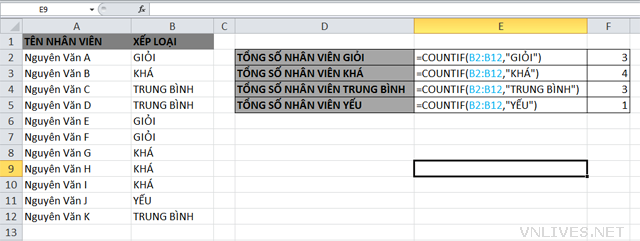
Như mô tả ở trên để đếm bao nhiêu nhân viên được loại giỏi, bao nhiều được loại khá,... tôi sẽ áp dụng công thức COUNTIF để thực hiện yêu cầu như sau:
Writer: +Bui Ngoc Son
Syntax - Cú pháp:
COUNTIF(range, criteria)
Explain - Giải nghĩa:
- range: một mãng (dãy) hoặc vùng các ô cần đếm, giá trị các ô có thể là text, tên, mảng, hay tham chiếu đến các ô chứa dữ liệu, ô rỗng sẽ được bỏ qua không đếm.
- criteria: điều kiện để đếm (số, chuỗi, biểu thức, …). Ngoài ra trong trường hợp ta không xác định được dữ liệu cần đếm cụ thể, ta có thể dùng ký tự đại diện như sau:
- ? đại diện 1 ký tự.
- ex: ta cần đếm số ô có các số bắt đầu bằng 3 số không và số cuối là số bất kỳ, thì công thức sẽ là [ COUNTIF(A1:A20,"000?") ]
- * đại diện nhiều ký tự.
- ex: ta cần đếm có bao nhiêu người họ BÙI trong danh sách, thì công thức sẽ là [ COUNTIF(A1:A20,"BÙI*") ]
Example - Ví dụ:
Như mô tả ở trên để đếm bao nhiêu nhân viên được loại giỏi, bao nhiều được loại khá,... tôi sẽ áp dụng công thức COUNTIF để thực hiện yêu cầu như sau:
Writer: +Bui Ngoc Son
Hàm ISNUMBER kiểm tra dữ liệu có phải kiểu số không.
Trong việc tính toán trong EXCEL, một số trường hợp bạn cần phải kiểm tra dữ liệu đầu vào có phải là số hay không? trước khi tính toán, để từ đây đưa ra hướng xử lý cho phù hợp khi gặp phải các giá trị không phải là số. Hàm ISNUMBER trong EXCEl sẽ giúp bạn kiểm tra một giá trị, hoặc tham số ô (cell) của excel truyền vào có phải là số hay không? Nếu là số thì trả về TRUE, ngược lại không phải là số thì trả về FALSE.
Syntax - Cú Pháp:
Explain - Giải nghĩa:
Example - Ví dụ:
Dưới đây tôi có mô tả một ví dụ đơn giản để sử dụng hàm ISNUMBER, tôi có một cột số và tôi dùng nó để xác định xem dữ liệu trong ô (cell) có phải là số hay không.

Actual example - Ví dụ thực tế:
Bây giờ ta sẽ đi qua một ví dụ thực tế đơn giản sau để hiểu rõ hơn cách áp dụng hàm ISNUMBER này. Giả sử tôi có một bản dữ liệu EXCEL tổng giờ làm của nhân viên như sau:

Bây giờ tôi cần tính lương thực lãnh là số giờ nhân cho lương cố định là 30 ngàn một tiếng, tức là lấy:

Như bạn thấy tại dòng dữ liệu cuối cùng số giờ của Tô Thị Ngọc Nhuận là (-) có thể là do chưa cập nhật, hay không có giờ làm việc chẳng hạng, vì dữ liệu là ký tự nên khi chạy công thức tính toán trong EXCEl ta sẽ bị báo lỗi #VALUE! như trên.
Để giải quyết trường hợp này ta sẽ áp dụng hàm ISNUMBER để kiểm tra dữ liệu đầu vào, nếu là kiểu số thì tính như bình thường, ngược lại thì ta cho trả về giá trị là 'KHÔNG CÓ TỔNG GIỜ LÀM VIỆC' chẳng hạn, ta sẽ có thông thức là

Writer: +Bui Ngoc Son
Syntax - Cú Pháp:
ISNUMBER(value)
Explain - Giải nghĩa:
- ISNUMBER: là hàm dùng để kiểm tra giá trị hoặc tham số ô (cell) của excel có phải là số không? Nếu là số thì trả về TRUE, ngược lại trả về FALSE.
- TEXT: là một văn bản, đoạn văn bản, hoặc nội dung văn bản của một ô tham chiếu ( ex: UPPER(A1) )
Example - Ví dụ:
Dưới đây tôi có mô tả một ví dụ đơn giản để sử dụng hàm ISNUMBER, tôi có một cột số và tôi dùng nó để xác định xem dữ liệu trong ô (cell) có phải là số hay không.
Actual example - Ví dụ thực tế:
Bây giờ ta sẽ đi qua một ví dụ thực tế đơn giản sau để hiểu rõ hơn cách áp dụng hàm ISNUMBER này. Giả sử tôi có một bản dữ liệu EXCEL tổng giờ làm của nhân viên như sau:
Bây giờ tôi cần tính lương thực lãnh là số giờ nhân cho lương cố định là 30 ngàn một tiếng, tức là lấy:
Tổng giờ làm việc * 30.000 = Lương thực lãnh
và kết quả tôi nhận được như sau:Như bạn thấy tại dòng dữ liệu cuối cùng số giờ của Tô Thị Ngọc Nhuận là (-) có thể là do chưa cập nhật, hay không có giờ làm việc chẳng hạng, vì dữ liệu là ký tự nên khi chạy công thức tính toán trong EXCEl ta sẽ bị báo lỗi #VALUE! như trên.
Để giải quyết trường hợp này ta sẽ áp dụng hàm ISNUMBER để kiểm tra dữ liệu đầu vào, nếu là kiểu số thì tính như bình thường, ngược lại thì ta cho trả về giá trị là 'KHÔNG CÓ TỔNG GIỜ LÀM VIỆC' chẳng hạn, ta sẽ có thông thức là
=IF(ISNUMBER(B2),30000*B2,'KHÔNG CÓ TỔNG GIỜ LÀM VIỆC'
và kêt quả tôi nhận được sẽ là.Writer: +Bui Ngoc Son
Hàm UPPER chuyển đổi định dạng chữ thành viết hoa.
Bạn có một danh sách EXCEL các tên khách hàng, hay nhân viên, nhưng tên của chúng do thu thập từ nhiều nguồn khác nhau, nên lúc thì chữ HOA, lúc thì chữ THƯỜNG, hoặc chữ HOA ĐẦU,... hay đơn giản chỉ là bạn muốn chuyển sang định dạng chữ hoa hết cho đẹp (ex: Bùi nGọc sơN → BÙI NGỌC SƠN), thì hàm (function) UPPER của excel sẽ hỗ trợ bạn thực hiện việc này.
Syntax - Cú Pháp:
Explain - Giải nghĩa:
Example - Ví dụ:
Như trong hình bên dưới tôi có một cột lưu trữ tên người với các định dạng khác nhau, nhìn rất phức tạp và không đẹp, vì thế tôi tạo một cột mới với công thức UPPER(), và tôi sẽ được một cột mới với các tên đã được viết hoa tất cả các chữ cái.

Writer: +Bui Ngoc Son
Syntax - Cú Pháp:
UPPER(text)
Explain - Giải nghĩa:
- UPPER: là hàm dùng để chuyển đổi văn bản thành định dạng chữ thường toàn bộ.
- TEXT: là một văn bản, đoạn văn bản, hoặc nội dung văn bản của một ô tham chiếu ( ex: UPPER(A1) )
Example - Ví dụ:
Như trong hình bên dưới tôi có một cột lưu trữ tên người với các định dạng khác nhau, nhìn rất phức tạp và không đẹp, vì thế tôi tạo một cột mới với công thức UPPER(), và tôi sẽ được một cột mới với các tên đã được viết hoa tất cả các chữ cái.
Writer: +Bui Ngoc Son
Hàm LOWER chuyển đổi định dạng chữ thành viết thường.
Bạn có một danh sách EXCEL các tên khách hàng, hay nhân viên, nhưng tên của chúng do thu thập từ nhiều nguồn khác nhau, nên lúc thì chữ HOA, lúc thì chữ THƯỜNG, hoặc chữ HOA ĐẦU,... hay đơn giản chỉ là bạn muốn chuyển sang định dạng chữ thường hết cho đẹp (ex: Bùi nGọc sơN → bùi ngọc sơn), thì hàm (function) LOWER của excel sẽ hỗ trợ bạn thực hiện việc này.
Syntax - Cú Pháp:
Explain - Giải nghĩa:
Example - Ví dụ:
Như trong hình bên dưới tôi có một cột lưu trữ tên người với các định dạng khác nhau, nhìn rất phức tạp và không đẹp, vì thế tôi tạo một cột mới với công thức LOWER(), và tôi sẽ được một cột mới với các tên đã được viết thường tất cả các ký tự.

Writer: +Bui Ngoc Son
Syntax - Cú Pháp:
LOWER(text)
Explain - Giải nghĩa:
- LOWER: là hàm dùng để chuyển đổi văn bản thành định dạng chữ thường toàn bộ.
- TEXT: là một văn bản, đoạn văn bản, hoặc nội dung văn bản của một ô tham chiếu ( ex: LOWER(A1) )
Example - Ví dụ:
Như trong hình bên dưới tôi có một cột lưu trữ tên người với các định dạng khác nhau, nhìn rất phức tạp và không đẹp, vì thế tôi tạo một cột mới với công thức LOWER(), và tôi sẽ được một cột mới với các tên đã được viết thường tất cả các ký tự.
Writer: +Bui Ngoc Son
Hàm PROPER chuyển đổi định dạng chữ thành viết hoa ký từ đầu mỗi từ.
Bạn có một danh sách EXCEL các tên khách hàng, hay nhân viên, nhưng tên của chúng do thu thập từ nhiều nguồn khác nhau, nên lúc thì chữ HOA, lúc thì chữ THƯỜNG, hoặc chữ HOA ĐẦU,... hay đơn giản chỉ là bạn muốn chuyển sang định dạng chữ hoa đầu mỗi từ cho đẹp (ex: bùi ngọc sơn → Bùi Ngọc Sơn), thì hàm (function) PROPER của EXCEL sẽ hỗ trợ bạn thực hiện việc này.
Syntax - Cú Pháp:
Explain - Giải nghĩa:
Example - Ví dụ:
Như trong hình bên dưới tôi có một cột lưu trữ tên người với các định dạng khác nhau, nhìn rất phức tạp và không đẹp, vì thế tôi tạo một cột mới với công thức PROPER(), và tôi sẽ được một cột mới với các tên đã được viết hoa chữ cái đầu tiên.

Writer: +Bui Ngoc Son
Syntax - Cú Pháp:
PROPER(text)
Explain - Giải nghĩa:
- PROPER: là hàm dùng để chuyển đổi văn bản thành định dạng chữ viết hoa đầu tiên cho mỗi từ.
- TEXT: là một văn bản, đoạn văn bản, hoặc nội dung văn bản của một ô tham chiếu ( ex: PROPER(A1) )
Example - Ví dụ:
Như trong hình bên dưới tôi có một cột lưu trữ tên người với các định dạng khác nhau, nhìn rất phức tạp và không đẹp, vì thế tôi tạo một cột mới với công thức PROPER(), và tôi sẽ được một cột mới với các tên đã được viết hoa chữ cái đầu tiên.
Writer: +Bui Ngoc Son
How to Convert Time to Seconds in Excel?
Trong các bài viết trước tôi có giới thiệu cách chuyển đổi thời gian (time) thành giờ (hours), và cách chuyển đổi thời gian (time) thành phút (minutes) trong Excel.
Trong bài viết này tôi xin giới thiệu thêm 2 phương thức chuyển đổi kiểu dữ liệu thời gian (time) thành kiểu dữ liệu số thâp phân giây (seconds) trong Excel.
Phương thức 1: Bạn làm theo công thức tại cột SECONDS = TIME *86400

Phương thức 2: Bạn làm theo công thức tại cột SECONDS = HOUR(A2) * 3600 + MINUTE(A2) * 60 + SECOND(A2), phương pháp 2 này thì phức tạp hơn khó nhớ hơn, tuy vậy cũng có rất nhiều người ưa thích cách này dù rắng chúng cho ra cùng một kết quả.

Bạn có thể tham khảo thêm một số cách chuyển đổi thời gian trong excel qua các bài viết bên dưới đây:
Trong bài viết này tôi xin giới thiệu thêm 2 phương thức chuyển đổi kiểu dữ liệu thời gian (time) thành kiểu dữ liệu số thâp phân giây (seconds) trong Excel.
Phương thức 1: Bạn làm theo công thức tại cột SECONDS = TIME *86400
Phương thức 2: Bạn làm theo công thức tại cột SECONDS = HOUR(A2) * 3600 + MINUTE(A2) * 60 + SECOND(A2), phương pháp 2 này thì phức tạp hơn khó nhớ hơn, tuy vậy cũng có rất nhiều người ưa thích cách này dù rắng chúng cho ra cùng một kết quả.
Bạn có thể tham khảo thêm một số cách chuyển đổi thời gian trong excel qua các bài viết bên dưới đây:
- Chuyển đổi thời gian (time) thành giờ (Hours).
- Chuyển đổi thời gian (time) thành phút (Minutes).
- Chuyển đổi thời gian (time) thành giay (Seconds).
Chuyển đổi thời gian (time) thành phút (minutes) trong Excel? | How to Convert Time to Minutes in Excel?
Trong bài trước tôi có giới thiệu cách chuyển đổi kiểu dữ liệu dạng thời gian (time - HH:MM:SS) thành kiểu dữ liệu dạng số thâp phân (hours) để thuận tiện trong việc tính toán, ví dụ như tính toán giờ công của nhân viên chẳng hạn.
Bài viết tiếp theo đây tôi xin giới thiệu tiếp hai cách cách chuyển đổi kiêu dữ liệu dạng thời gian (time) thành kiểu dữ liệu số phút (minutes) trong excel.
Phương thức 1: Bạn làm theo công thức tại cột MINUTES = TIME *1440

Phương thức 2: Bạn làm theo công thức tại cột MINUTES = HOUR(A2) * 60 + MINUTE(A2) + SECOND(A2) / 60, phương pháp 2 này thì phức tạp hơn khó nhớ hơn, tuy vậy cũng có rất nhiều người ưa thích cách này dù rắng chúng cho ra cùng một kết quả.

Bạn có thể tham khảo thêm một số cách chuyển đổi thời gian trong excel qua các bài viết bên dưới đây:
Bài viết tiếp theo đây tôi xin giới thiệu tiếp hai cách cách chuyển đổi kiêu dữ liệu dạng thời gian (time) thành kiểu dữ liệu số phút (minutes) trong excel.
Phương thức 1: Bạn làm theo công thức tại cột MINUTES = TIME *1440
Phương thức 2: Bạn làm theo công thức tại cột MINUTES = HOUR(A2) * 60 + MINUTE(A2) + SECOND(A2) / 60, phương pháp 2 này thì phức tạp hơn khó nhớ hơn, tuy vậy cũng có rất nhiều người ưa thích cách này dù rắng chúng cho ra cùng một kết quả.
Bạn có thể tham khảo thêm một số cách chuyển đổi thời gian trong excel qua các bài viết bên dưới đây:
- Chuyển đổi thời gian (time) thành giờ (Hours).
- Chuyển đổi thời gian (time) thành phút (Minutes).
- Chuyển đổi thời gian (time) thành giay (Seconds).
Chuyển đổi thời gian thành giờ trong Excel? | How to Convert Time to Hours in Excel?
Bạn có một cột dữ liệu trong excel lưu lại số giờ làm việc của nhân viên của bạn theo dang Time, ví dự HH:MM:SS, tuy nhiên khi nhìn như vậy thì sẽ rất rối, cũng những rất khó khăn khi tính toán số giờ làm việc của một nhân việc, vì vậy việc chuyển đổi dữ liệu định dạng thời gian Time thành kiểu dữ liệu dạng giờ (hours) hay nói chính xác là chuyển thành dạng số thập phân.
Bài viết này xin hướng dẫn các bạn hai cách chuyển đổi kiểm dữ liệu dạng thời gian (Time) thành số giờ theo dạng số giờ thập phân (Decimal )
Phương pháp 1: Bạn làm theo công thức tại cột HOURS = TIME * 24

Bài viết này xin hướng dẫn các bạn hai cách chuyển đổi kiểm dữ liệu dạng thời gian (Time) thành số giờ theo dạng số giờ thập phân (Decimal )
Phương pháp 1: Bạn làm theo công thức tại cột HOURS = TIME * 24
Nối nhiều tập tin excel có nhiều sheet thành một tập tin excel duy nhất theo các sheet tương ứng bằng macro trong excel 2010.
Tiếp theo trong chủ đề nối nhiều tập tin excel thành một tâp tin duy nhất, bài này tôi xin hướng dẫn cách gom nhiều tập tin excel có nhiều sheets khác nhau thành một tâp tin excel duy nhất dữ liệu của các sheet sẽ được copy tương ứng vào các sheets của tập tin duy nhất này. (How to combine multiple excel have multi sheets in one file by marco in Excel 2010?)


Subscribe to:
Posts (Atom)